✳Business & Property
One key for the owner, one per unit, one for the cleaner. How a system is laid out before any cylinder is pinned — and the mistake that makes it unmaintainable in two years.

✳On this page
A master key system is not a product you buy; it is a design you commission. The hardware is ordinary — the value is entirely in the layout, and that is decided on paper before a single cylinder is pinned.
The hierarchy, in plain terms
- Change key — opens one door. The tenant's key, the office key.
- Master key — opens a defined group. All units on a floor; all offices in a suite.
- Grand master — opens every group beneath it. The owner or manager.
Above three levels, complexity grows quickly and so does the number of unintended key combinations. Most buildings under fifty doors are well served by two or three.
Start with a matrix, not with hardware
List every lockable opening down one side of a page: unit doors, mechanical rooms, storage, laundry, roof access, mailroom, exterior doors. List every holder across the top: owner, manager, each tenant, cleaner, contractor, fire service. Tick every cell where access is genuinely needed.
The matrix is the design. It also exposes the requirements people forget until the system is already pinned — the cleaner who needs the laundry room but not the units, the contractor who needs mechanical but nothing else, the fire service box that has its own rules.

Key control is the decision you cannot undo
If your building's blanks are the ones sold in every hardware store, then a key handed to a contractor for an afternoon can come back with a copy behind it, and you will never know. A restricted keyway means blanks are controlled by the manufacturer and cut only against an authorisation list you maintain.
This costs more per cylinder and it is the single decision most worth getting right, because changing it later means replacing every cylinder in the building. Decide it before hardware is ordered.
The mistake that makes a system unmaintainable
Specifying it exactly to today's requirement with no room to grow. Two years later there is a new tenant, a split unit, a new role, and no unused change keys left — so the choice becomes repinning the building or bolting on a lock that sits outside the system entirely. The second option is what usually happens, and after a few of them the building has a master key system plus eleven exceptions, which is not a master key system.
Ask for unused change keys in the specification and at least one spare group in reserve. It costs nothing at design time.
Documentation is part of the deliverable
A system should come with the bitting list, the hierarchy diagram, and a register of who holds which key. Store it off-site, because the manager who commissioned it will not always be the manager who needs it. Update the register at every handover — a key issued and never recorded is a key that is still out there when the tenancy ends.
Where this meets tenancy law
Changing a unit cylinder within a system is still a lock change on a unit door, and the same rules apply — the fact that a building runs a master key system grants nothing extra. Before a turnover rekey, read what the Residential Tenancies Act allows.
And if the building has exit doors with panic hardware, they carry their own obligations that master keying does not override — that is panic bars and fire code.
(01)Step by step
How to do it
- Time needed
- PT2H
- 01
List every door and every holder
Write out every lockable opening in the building and, separately, every person or role that needs access. Do not design anything yet — this is inventory.
- 02
Draw the matrix
Put doors down one axis and holders across the other, and tick each cell where access is required. The pattern that emerges is the system; the hierarchy is derived from it rather than imposed on it.
- 03
Choose the keyway and the level of key control
Decide whether blanks should be freely available or restricted to an authorised dealer. This choice cannot be changed later without replacing every cylinder, so it is made before hardware is bought.
- 04
Leave expansion room
Specify the system with unused change keys and at least one spare level in reserve, so that adding a unit or a role later does not require repinning the building.
- 05
Document it and keep the record off-site
Record the bitting list, the hierarchy and who holds which key, and store it somewhere that survives a change of manager. An undocumented system is one that must be rebuilt from scratch the first time anything changes.
(02)Objections
Frequently asked
- Does master keying weaken the locks?
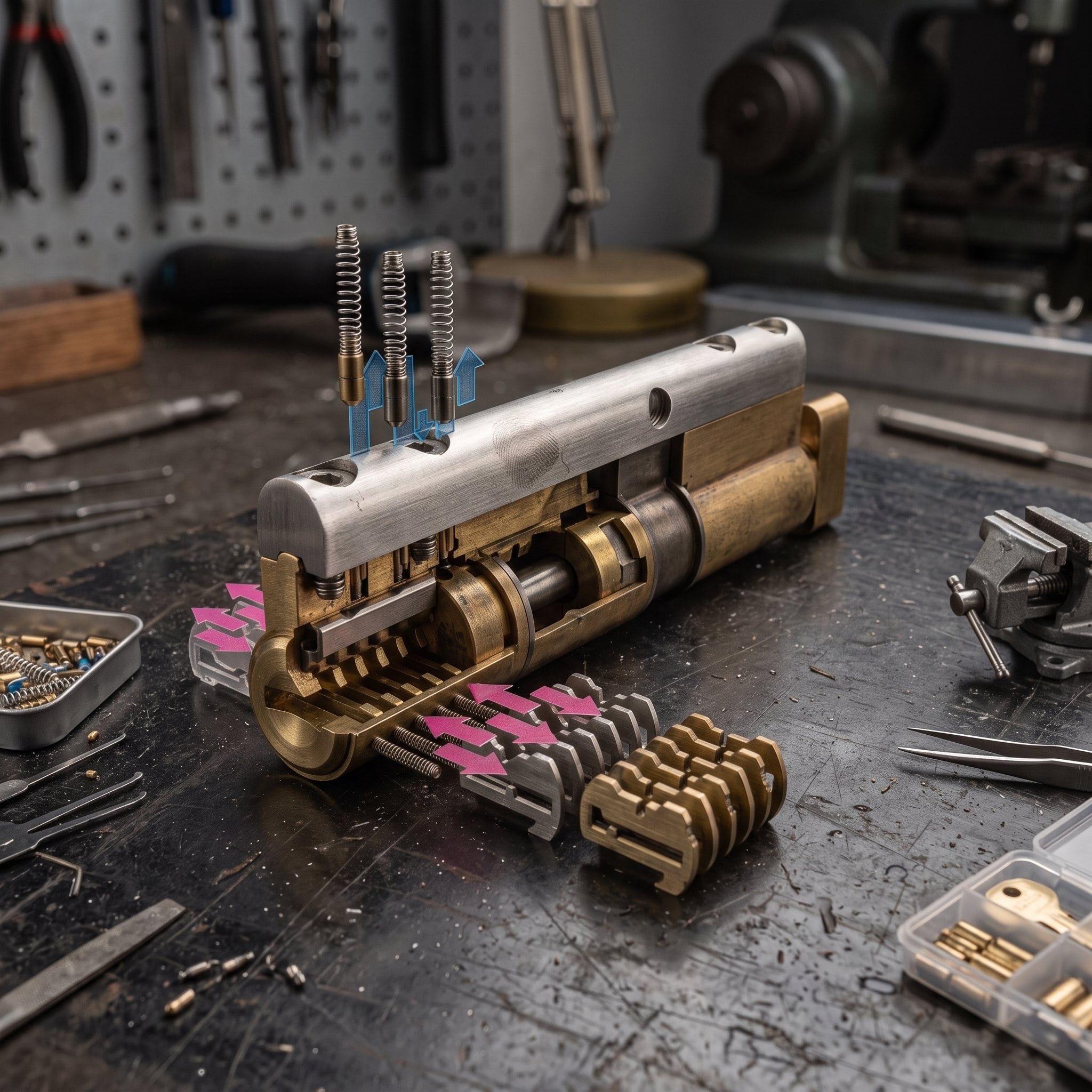
- It adds master wafers to each pin stack, which creates additional positions where the plug can turn and does slightly reduce manipulation resistance. It is a well-understood trade-off, and it is managed by choosing a good cylinder and restricting the keyway rather than by avoiding master keying.
- What is a restricted keyway?
- A keyway whose blanks are not sold openly — they are controlled by the manufacturer and supplied only to an authorised dealer, usually against a signed authorisation list. It means nobody can walk into a hardware store and copy a key to your building.
(03)Ask
Have a question about this?
Questions are read by a person and answered here on the page. We don't collect your email, so we can't reply privately.
(04)Written by
LAK Locksmith Team
Locksmiths and key technicians
LAK Locksmith has been working across the Greater Toronto Area since 2021, from 470 N Rivermede Rd in Vaughan. These guides are written by the technicians who do the work — residential, commercial and automotive — and are kept to what can be demonstrated on a doorstep rather than what sells.
All articles by LAK Locksmith Team